
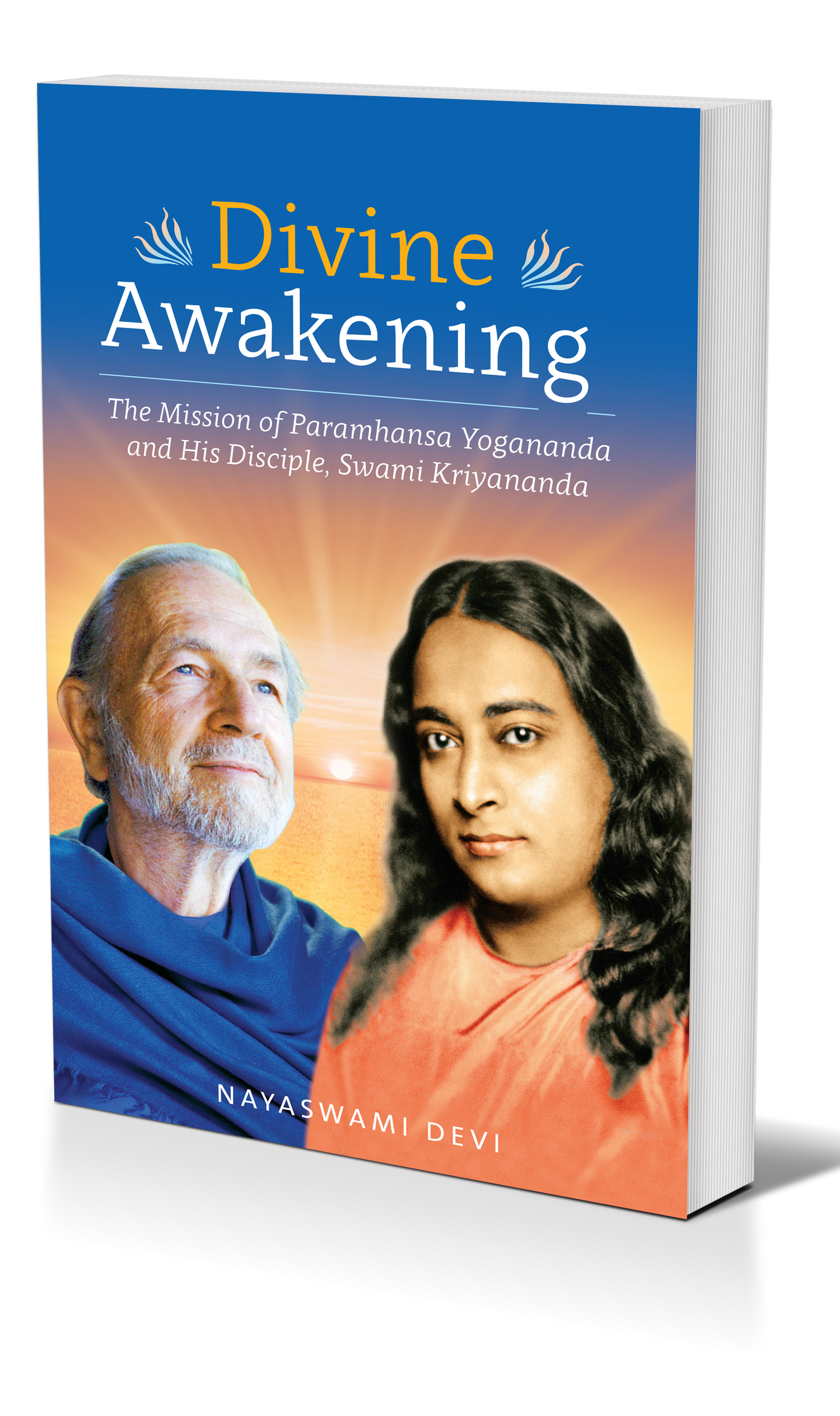
Yogananda gave the world a vision of global unity—an underlying consciousness connecting all people, religions, and nations. According to his teachings, beneath the seemingly separate waves of creation lies the one vast ocean of Spirit.
Even the monastic name he chose, "Yogananda," expresses unity. "Yoga" means union, and "ananda" means bliss: thus, bliss through union with God. His life and teachings consistently embody this unifying truth.
He also demonstrated practical applications of energy to improve every aspect of life—business, leadership, relationships, education, the arts, health—addressing most importantly the states of consciousness underlying them all. When asked whether he had brought a new religion, he replied, "It is a new expression." His teachings were eternal truths adapted to modern understanding, with spiritual techniques suited to contemporary needs.
Philip Goldberg wrote in his book The Life of Yogananda: "In the course of hundreds of conversations over the decades, I came to realize how many lives Yogananda has impacted. While researching my book, American Veda, I came to see him as a teacher for the ages, whose contribution to the transmission of India's ancient wisdom to the West was incomparable".
These points from his own mission statement, "Aims and Ideals," as it appeared in the 1955 edition of Autobiography of a Yogi, capture the scope of that contribution:
"To disseminate among the nations a knowledge of definite scientific techniques for attaining direct personal experience of God." Yogananda introduced the techniques of Kriya Yoga and meditation to the West. Because it works through the conscious direction of subtle energy, Kriya Yoga is ideally suited to the consciousness of Dwapara Yuga. It is estimated that he personally initiated over one hundred thousand people in this technique.
"To prove the practical truth in the immortal teachings of Jesus Christ and of the Self-realized masters of India." He taught the underlying similarities between Christianity and Hinduism, and how their shared truths can be applied in daily life. He showed that the quest for God brings true happiness and success on every level.
"To point out the one highway to God on which all bypaths of religious beliefs meet—the highway of daily scientific meditation to attain divine communion." The Master taught that the goal of all religions is the same: union with God. Looking beyond the limited thinking of Kali Yuga, he offered meditation techniques that would awaken a new vision of unity for all cultures, races, and religions.
"To heal and liberate man from his threefold suffering: physical disease, mental inharmonies, and spiritual ignorance." Yogananda provided practical methods to improve life on all levels through specific teachings like the energization exercises, his “unique contribution to the science of yoga”; affirmations; and proper diet. Many aspects of his teachings on health and healing have now been supported by modern research.
"To attain threefold perfect development: body, mind, and soul." He created a new approach to learning: "how-to-live" education, which leads to balanced, harmonious development in children and adults alike. Such an approach, which addresses all aspects of body, mind, and soul, helps mankind develop to its full potential.
"To further a spiritual and cultural understanding between East and West, and to promote an exchange of their finest distinctive features." Yogananda saw India's gift to the world as spiritual wisdom, and America's as practical efficiency. In learning from each other, the two cultures can model an ideal way of life, and lead the world forward toward a unified Dwapara Yuga culture.
"To harmonize science and religion through study and practical realization of the unity of their underlying principles." He felt that with the current emphasis on science over religion, it was time to break down the barriers between the two. He taught that yogic techniques and practices are, like science, based not on blind faith, but on experimentation and direct experience.
"To spread a spirit of brotherhood among all peoples; and to aid in establishing, in many countries, self-sustaining world brotherhood colonies for 'plain living and high thinking.'" Yogananda often spoke of such colonies, which he declared would "spread like wildfire" in the future, and become the social pattern for the new age. World brotherhood colonies would offer people an integrated life, with "home, job, and church in one place": a simpler, more fluid, and more personally oriented way of living.
"To serve mankind as one's larger Self." His whole mission was based in service to humanity. Yogananda's thirty-two years of selfless dedication in that pursuit created a wave of spiritual energy that, long after his passing, continues to touch lives around the world.
--Excerpt from Divine Awakening by Nayaswami Devi



1 comment
Juan Lara
Leave a comment
This site is protected by hCaptcha and the hCaptcha Privacy Policy and Terms of Service apply.